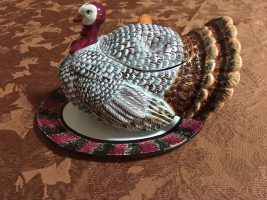
There is virtually no aspect of our lives over which laws and ordinances do not reign. Even the Thanksgiving menu is laden with regulatory dos and don’ts. Some may be justified as safeguarding public health and safety, but thousands of others are simply the meddling of an administrative state that is threatening to transform us into regulatory serfs.
Lest there be any doubts about the extent of the problem, here is just a taste of the regulatory minutiae that still control our Thanksgiving menu:
Turkey
9 CFR § 381.76 still directs USDA inspectors on how to examine poultry carcasses. For frozen birds: “If a carcass is frozen, it shall be thoroughly thawed before being opened for examination by the inspector.” Every carcass (or all parts of it) must be individually examined—except for parts the inspector decides are not needed.
Cranberries
The cranberry marketing order (7 CFR Part 929) was suspended in 2022 by the USDA after years of industry pressure and legal challenges. As of 2025, there is no longer a federal volume-control or allotment system in place for cranberries. Growers in the ten regulated states are now free to ship whatever volume they choose without USDA-imposed quotas. (So cranberries are one of the rare Thanksgiving items that actually escaped the regulatory turkey pen in recent years.)
Bread/Rolls
21 CFR § 136.110 still requires that anything labeled “bread” (as opposed to “rolls,” “buns,” etc.) must weigh at least one-half pound after cooling. Anything smaller cannot legally be called “bread” in interstate commerce.
Potatoes
The tolerances in 7 CFR § 51.1546 for “U.S. No. 1” potatoes remain essentially unchanged: maximum 5 % serious damage by external defects, 5 % internal defects, and a total of 1 % for potatoes frozen or affected by soft rot or wet breakdown at shipping point. Separate (slightly more lenient) tolerances still apply en route or at destination, and there are still detailed standards for U.S. No. 2, U.S. Commercial, and off-size categories.
Green beans (canned)
21 CFR § 155.120 still contains the delightfully bureaucratic botanical definition: green beans and wax beans must come from “succulent pods of fresh green bean or wax bean plants conforming to the characteristics of Phaseolus vulgaris L. and Phaseolus coccineus L.,” and they must be either “green” or “wax,” with two official width-to-thickness ratios that determine whether they are stylistically “regular” or “flat” beans.
Cornmeal (for stuffing)
21 CFR § 137.275 still defines yellow cornmeal almost exactly as originally written: it “conforms to the definition and standard of identity prescribed by § 137.250 for white cornmeal except that cleaned yellow corn is used instead of cleaned white corn.”
Pecans
Country-of-origin labeling for pecans (and most muscle cuts of meat, fish, and certain nuts) is now governed by 7 CFR Part 60. The basic rule—no flags, no abbreviations, but adjectival forms (e.g., “Georgia Pecans”) are fine as long as they don’t misleadingly suggest a variety name—remains accurate.
All of this regulation (minus the recently liberated cranberry) still raises the same simple question: Who, exactly, are the actual turkeys?